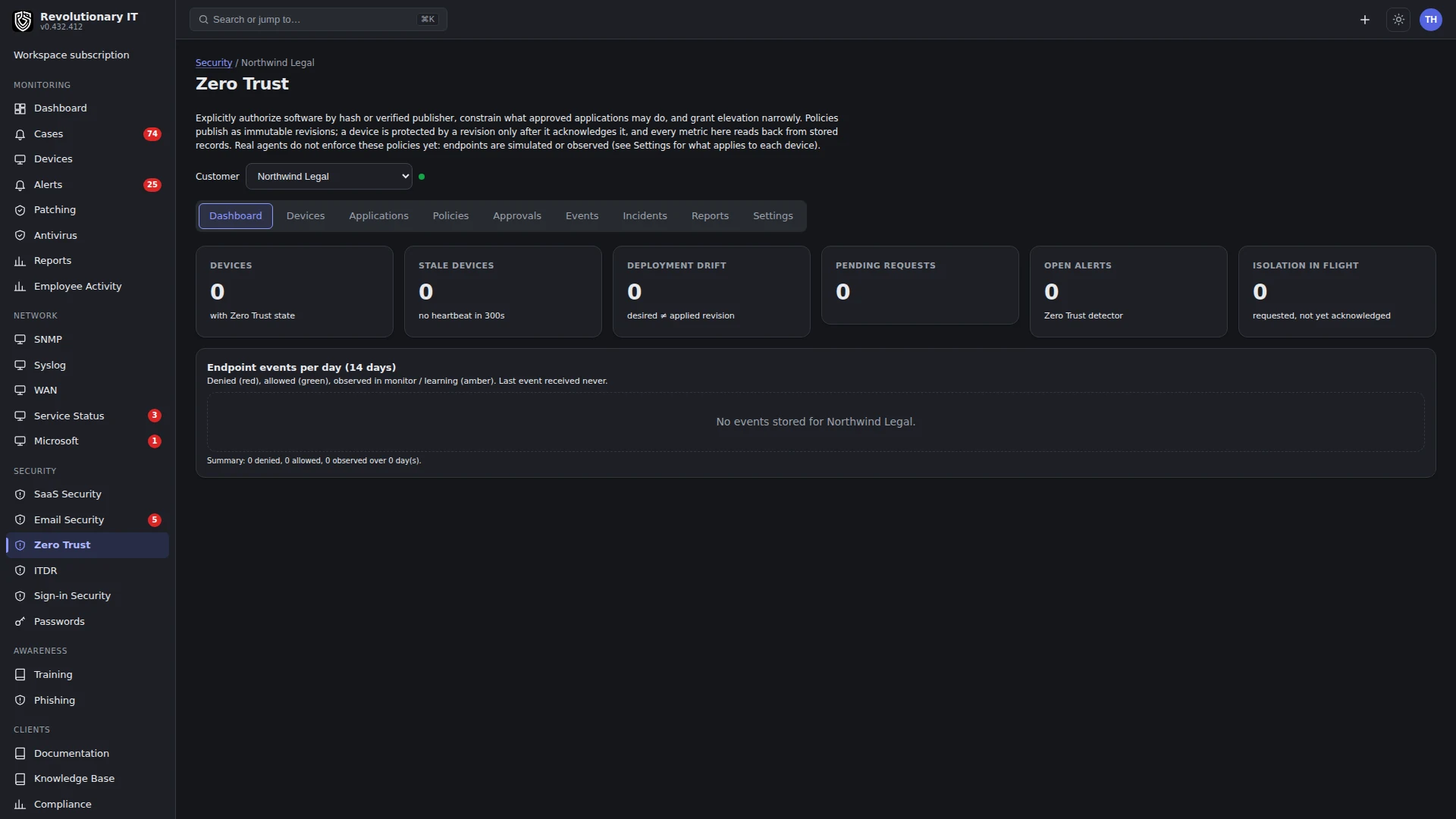
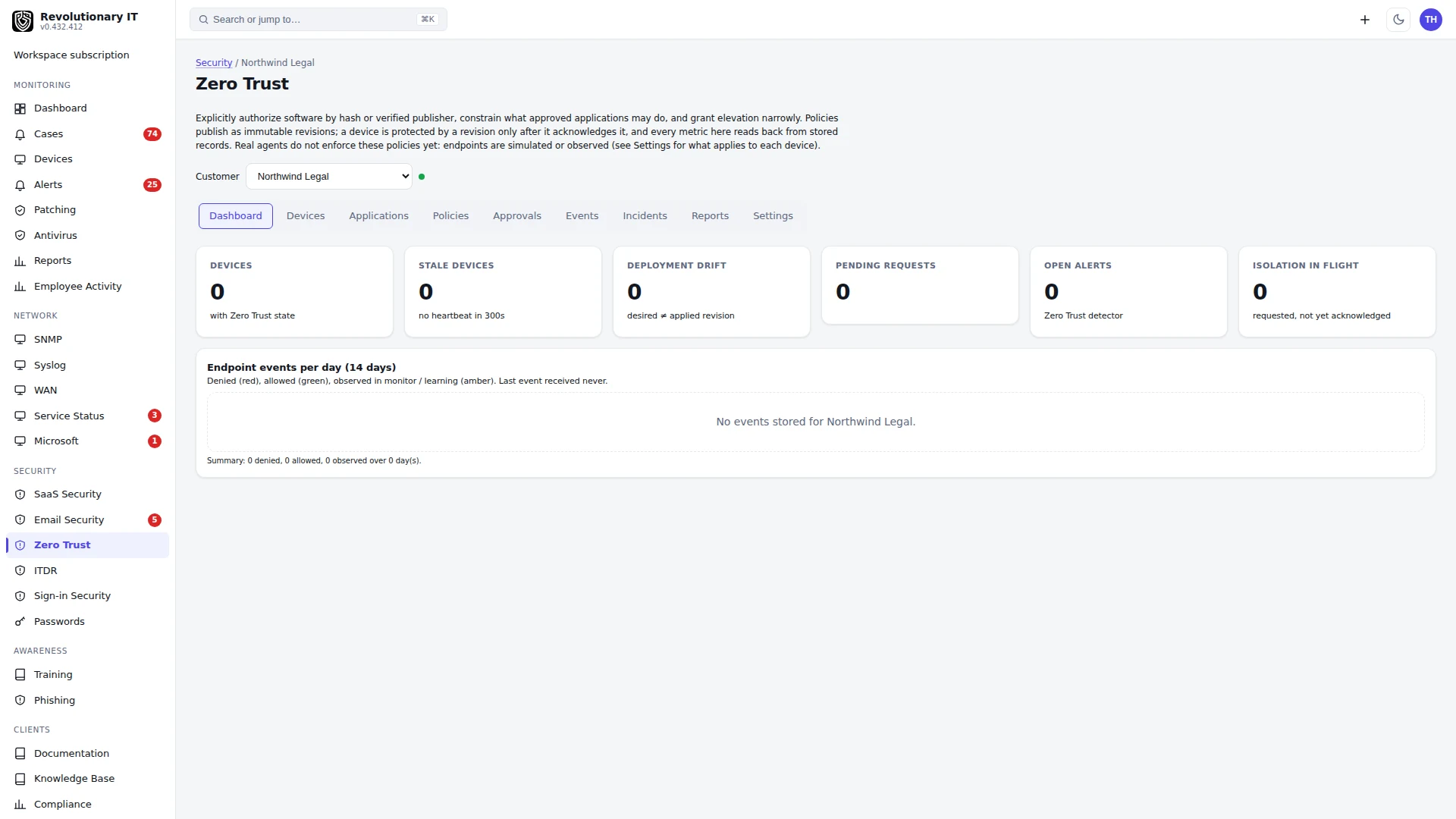
Zero Trust control-plane preview
Video guide: Inspect the Zero Trust control-plane preview honestly
Recorded October 22, 2026 in the fictional Summit Managed IT staging workspace, App 0.432.1. The deployed demo can differ from the current product; use the written guide for current behavior. Read-only reference-device records; no native prevention, isolation, enrollment or policy change.
Full narration captions are included in the video. Open video full screen · Download subtitles · Download transcript
Video transcript
Open Zero Trust for Northwind Traders. This is the control-plane preview. Real desktop agents do not enforce these policies yet. Simulator or observed acknowledgements are not native prevention or endpoint protection. The old offline demo records help explain the interface, not prove security enforcement.
Open Devices and read the simulated endpoint state and last heartbeat. Desired and applied revision fields describe stored control-plane records. A simulated acknowledgement cannot show that Windows or another operating system blocked an application or isolated a real computer.
Open Policies, then Events. Drafts and published revisions are separate lifecycle records, and event rows must be interpreted with their source and age. Do not treat a populated table as an enforcement acceptance test. No token is issued, no simulator is seeded and no security policy is changed in this walkthrough.
Preview/reference workflow: real desktop agents do not enforce these Zero Trust policies yet. Security > Zero Trust stores policy, application, approval, event and delivery state and offers a simulator/reference workflow. It must not be used as evidence that Windows, macOS or Linux execution is protected by allowlisting, containment or elevation enforcement.
What is implemented
- Staff access is role/permission gated and scoped to visible customers. Devices, applications, policies, approvals, events, incidents, reports and settings have dedicated tabs.
- A reference evaluator handles ordered rules, hash/publisher identity, allow/deny/spawn/elevate decisions, missing attributes and scoped grants. These decisions are modelled evaluations, not a native enforcement driver.
- Publishing snapshots rules/grants into immutable revisions and queues delivery through an outbox. Rollback republishes older content as a new revision. Stored delivered/applied acknowledgements describe that protocol/reference state.
- Approval requests carry device/user/hash/context and can issue bounded grants. Version checks prevent two reviewers silently overwriting the same decision. Grants expire through the tick job.
- Events and incidents can be read, filtered and reported; the tick job also handles outbox expiry/retention. Scheduled source configuration is not proof that a live job ran successfully.
Use the preview
- Open Security > Zero Trust, choose the intended customer and inspect its recorded state. An Enforce mode label is not proof of endpoint protection.
- In a permitted reference/simulator environment, inspect applications, rules and scoped approval requests. The simulator is available only where the operator has enabled it; this guide does not authorize enabling it in production or enrolling a customer endpoint as a simulation.
- Review a policy and publish its revision. Check the recorded outbox, acknowledgement and reference evaluation rather than claiming the computer now blocks software.
- Review a narrow grant and its expiry; use recorded simulation results to check which reference rule would win. Admission/approval is not actual privileged application execution.
- Inspect Events, Incidents and Reports with their source timestamps and simulation/reference context.
Verification and troubleshooting
A meaningful preview check follows a reference device through publication, recorded delivery/acknowledgement, policy evaluation, request/grant and expiry. Simulator success does not establish native prevention, tamper resistance or real isolation/recovery.
If a revision stays queued, inspect the reference client's heartbeat and the tick job's actual outcome. If evaluation differs from expectation, inspect rule priority and exact device/user/hash/grant scope. Do not weaken an actual endpoint security policy merely to make preview state say Applied.
Use antivirus monitoring, EDR connectors and Device Security for their separately implemented endpoint paths and platform limits. Their existence does not make this preview a native allowlisting product.